A Grown-Up Holiday For A Half-Grown Industry
Prepare to see a lot of 4/20 content in the next 24 hours. In your email inbox from a retailer in your ZIP code. In your LinkedIn feed from a brand that wants to remind you it exists. On a billboard in the states that still allow them. In the sponsored slot at the top of this newsletter and twenty others like it - sorry, not sorry, we have to pay the bills! The content is not uniform, but the frequency is unmistakable. 4/20 is now loud enough to reach you whether you are looking for it or not.
Depending on who you are, one of three things happens when that content shows up. The advocate who spent years throwing rocks at the castle rolls their eyes. The operator curating a menu year round snickers. The former regulator pauses for a second and thinks about how far all of this has come.
All three reactions are reasonable. All three are looking at the same moment.
The cannabis industry in 2026 is holding all three of those reactions at once because it is not yet the thing any one of them describes. Rescheduling is supposedly in motion. It is not done. The federal hemp definition narrows in November. Advertising restrictions still force operators to talk around their own products on the platforms where most of us actually live. Access stops at state lines, and the federal government is still arresting people for carrying cannabis across them. The industry is growing up. It is not yet fully grown.
That is the backdrop to this 4/20, and it is why the same stretch of feed, the same retailer email blast, the same trade-press splash lands three different ways on three different audiences.
Courtesy: Ben & Jerry’s
I wrote a blog last year about what 4/20 was. The Marin County kids in 1971, the Grateful Dead network that carried the shorthand across state lines, the High Times flyer, the courthouse lawns where smoke-outs functioned as civil disobedience. That piece was about what the day meant on the way up. This one is about what it means now, which is a harder question than it looks.
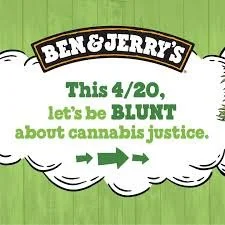
The advocate eye-rolls because the day that was invented to defy cannabis prohibition is now being used to move inventory. Carl's Jr. sells a $4.20 Snack Sack. Ben & Jerry's has a flavor. SaaS vendors who build dispensary websites have productized "Season Page Templates" so operators can run Green Wednesday, Danksgiving, Black Friday, and Cyber Monday as a coordinated four-day push, the same way Target does. The phrase "cousin walk" now appears in dispensary marketing copy as a product-category reference. 7/10 is now a concentrate holiday. Hint: the word "OIL" flipped upside down is 7/10. Dispensaries run it like Prime Day. Some of this is even charming. A holiday that once meant people gathering on a courthouse lawn at 4:20 PM to get arrested in protest is now one date on a promotional calendar that also includes a second cannabis holiday the industry invented for itself. The eye-roll is what that gap sounds like.
The snicker belongs to the operator. The operator sees the 4/20 content and sees, underneath it, a compliance regime that makes cannabis one of the most tightly regulated consumer categories in the country. Seed-to-sale tracking on every plant. Testing panels that have doubled in the last five years. Packaging rules that turn a label into a legal document. Security cameras on every square inch of licensed premises. License fees that run into six figures and insurance that barely exists outside specialty carriers. Bare bones banking that charges a premium when it is available at all. 280E turning tax season into a math problem most accountants cannot solve without specialty training. On top of that sits a second layer of restrictions from the platforms where modern consumer businesses actually reach people. Google will not sell paid search. Meta will not run paid Instagram or Facebook ads for a THC product. Shadow bans for saying “cannabis” instead of “c@nnabi$.” TikTok enforcement can erase a brand's account overnight. The 4/20 push is, itself, a workaround. It is what brand-building looks like when every normal channel has been closed or capped. The snicker is knowing, the way anyone snickers at a hack they have deployed because the front door was locked. The social movement that built the political case for legalization ran on the language of freedom. The industry that movement produced is one of the most constrained commercial categories ever built. Free the plant. Ha.
“The rules I helped write, and the rules every other state’s regulators wrote alongside the program I oversaw, were not the opposite of the movement. They were its translation.”
The former regulator was around for the earlier version. That’s me. I came to cannabis through health care policy, not through any social movement. The advocates made the introduction. They were generous with their culture, their history, their science, their know-how, and their intent, and they were patient with a policy millennial who showed up knowing very little beyond the levers of government. The rules I helped write, and the rules every other state's regulators wrote alongside the program I oversaw, were not the opposite of the movement. They were its translation. Testing exists because the only way to prove a product is not contaminated is to test it. Security cameras on every square inch of licensed premises exist because law enforcement needed a reason to stand down, and visible surveillance was a reason they would accept. Age-gating exists because limiting youth access was the political floor beneath everything else. Regulate it like alcohol they said. Seed-to-sale tracking exists because a regulated market has to be able to prove it is regulated, especially when you’re the first East Coast state and a potentially hostile DOJ is watching. Is it overkill in places? Sure is. Some of it will get pared back as the federal picture catches up and as the industry proves what it has already proven in practice. We’re seeing that. But the full apparatus was not a betrayal of legalization. It was the cost of it. The receipt for moving cannabis from counterculture to community fabric was a compliance regime dense enough to satisfy a skeptical public that had spent decades being told to fear a plant.
And the fabric is real. Cultivation now sits in industrial parks without drawing a second look. It sits in agricultural fields alongside corn and soy, the only caveat being that a neighbor's pesticide drift can still wreck your harvest. Retail has filled vacant storefronts in bustling downtowns, paying the cannabis premium on rent that zoning permits. Those are not small things. Those are the markers of a commercial category that belongs in the landscape. That is growing up. Being grown up is future-tense. The industry is in the verb right now. It has not arrived at the state.
All three of those reactions are in the industry right now. They are not in three different rooms. They are in the same meetings, the same trade associations, the same Slack channels, the same Sunday newsletters (btw, have you told a friend to subscribe yet? hint hint). Anyone who has spent real time in cannabis policy has held at least two of them in the same afternoon.
“The receipt for moving cannabis from counterculture to community fabric was a compliance regime dense enough to satisfy a skeptical public that had spent decades being told to fear a plant.”
None of the three, on their own, covers the ground floor of why 4/20 exists in the first place. The day began as a protest against a set of laws that put people in cages for carrying this plant, and those laws are not a historical artifact. They are still working. People are still in federal and state prisons for cannabis offenses that would be legal purchases in the state next door. Records from arrests decades old still show up in background checks for jobs, leases, and custody hearings. The communities that got policed hardest during prohibition are the communities that got excluded hardest from licensure. The Last Prisoner Project still has a caseload. The expungement work is not finished in any state. Every operator running a 4/20 sale this weekend is running it on top of that floor, whether the marketing copy acknowledges it or not. A maturing industry does not get to skip the part where it reckons with the people who paid the price for the market that now exists. 4/20 is the one day a year that question is unavoidable.
Which is why the week leading into 4/20 matters.
On Thursday, the Massachusetts Cannabis Control Commission voted 3-1 to freeze new cultivation licenses for 120 days. The vote was taken days before the commission is scheduled to dissolve under legislation sitting on the governor's desk, with a 30-day clock on new leadership appointments set to start the moment she signs today. There was an invitation for feedback that looked more like limited testimony than process. There was no promulgated regulation. The same 3-1 vote that imposed the freeze can reverse it at the next meeting, or modify it, or turn it on a different license class entirely, and the incumbent operators who lobbied for supply restriction because it protects the value of the licenses already in the market should read that sentence twice. Cultivators in Massachusetts have watched flower prices collapse from $401 an ounce in late 2020 to $113 in late 2025. 31 licensees across the supply chain are in court-appointed receivership. Remember, that is individual licenses, not necessarily individual entities. The price compression is real. Nobody is denying it. The question a regulator has to answer before voting a moratorium is whether the agency exists to monitor market conditions or to manipulate them. A supply freeze imposed by vote, without a promulgated rule the industry can plan against, reads as a market-structure decision dressed as enforcement, and the social equity applicants holding cultivation grants they now cannot use will be the first to test it in court.
That same week, in Boston, Pure Oasis closed. The first Black-owned adult-use dispensary in the city shut down with roughly $400,000 in unpaid state taxes, six vendor lawsuits, and a judgment over $2.2 million against it. The public framing offered by its co-owner was bureaucratic delay in releasing a Cannabis Social Equity Trust Fund grant. The record shows taxes in arrears well before the state froze the account. Entities are custodians of tax payments that are made by the consumer. They’re a custodian. We pay, then they remit. That is an operator obligation. The equity conversation Massachusetts still needs to have about sustaining licensees through 280E exposure, oversupply, and brutal price compression does not rewrite the part where Pure Oasis's own books did not work.
In Rhode Island, a federal judge's preliminary injunction against the state's 51 percent in-state ownership requirement has frozen the adult-use license lottery. Applicants who followed every rule the state set are now speaking in painful specifics about what they have spent. One reports at least $100,000 pursuing a worker cooperative license. Others are locked into lease costs with nothing to show for them. Meanwhile, the eight incumbent retailers carried over from the medical program generated roughly $120 million in 2025 without the competitive pressure the equity lottery was supposed to create. Market monitors, or market participants?
In Virginia, Governor Abigail Spanberger signed, on the same day, two bills and a set of amendments that capture the industry's partial state with unusual clarity. She signed legislation allowing medical cannabis use in hospital settings, ending a seven-session fight. She also signed legislation protecting the parental rights of adults who lawfully consume. Those are real wins for patients and families. In the same legislative action, she sent back amendments to the adult-use retail bills. In addition to pushing the start back by six months in 2027, those amendments reinstate public-use criminal penalties. They impose a mandatory minimum $500 fine and a driver's license suspension for possession by anyone under 21. They create a class 2 felony punishable by life in prison for illegal sale of 50 pounds or more. She also eliminated the Cannabis Equity Reinvestment Fund, routed all revenue into the general fund, and cut purchase amounts below what lawmakers had approved. The bill's sponsors called the substitute a significant departure from the framework they passed. Virginia NORML called it another page from the prohibitionist playbook.
Four stories, four different kinds of governance stress, in the week leading into the industry's largest commercial day of the year.
None of this is 4/20's fault. The “holiday” did not cause any of it. The week is a reminder that serious cannabis policy work in 2026 is harder, slower, and more contingent than the promotional calendar suggests. A retailer running a coordinated 4/20 campaign across email, LinkedIn, and a sponsored newsletter slot (another hint - this could be you! reach out!) is a sign of a category maturing into a normal consumer business. A state regulator voting a moratorium without a public record, a first Black-owned shop closing without its books adding up, a federal court freezing an equity lottery years after the state should have resolved the question, a governor reinstating life-sentence felonies on the same day she expands medical access. Those are signs of a category still figuring out what kind of industry it is going to be.
One path is that the cultural content of 4/20 carries forward deliberately. A portion of the industry's revenue flows to expungement work and legacy-market relief. Operator communications acknowledge the origin story. The day stays marked culturally the way Labor Day is still about labor, in ways most Americans do not notice but historians and the people inside the work do. The celebration and the history coexist, and the industry takes responsibility for both.
Another path is that the cultural content sheds. 4/20 becomes what Cyber Monday is: a revenue play, a planning horizon, a reason to build a landing page. That is the path of least resistance and the path most consumer categories actually walk. Nobody calls it dishonest. It is just how commerce metabolizes culture when the culture stops being load-bearing. Labor Day often equals back to school savings, after all.
A third path is that the culture moves outside the industry. The civil liberties work, the expungement fight, the legacy-market advocacy, the still-incarcerated cases. That work continues under the auspices of advocacy organizations, current and former operators, and the people who have been doing it the whole time. The industry runs its promotions. The advocates run their campaigns. They stop pretending to be the same thing, and both may be more honest for it. We can all stand to be a bit more active in this lane, by the way.
None of those paths is waiting for a vote. All three are already being walked, in different operators and different states. What we call the cannabis industry in 2026 is already three industries sharing a label, and 4/20 is one of the few days a year when that fact becomes visible.
Here is the part I did not expect to land on when I started writing this.
The eye-roll and the snicker and the quiet reflection are not three different people. They are three different moments in the same person. Most of us who have spent real time in this industry have had all three in a single week, sometimes a single afternoon. The advocate who eye-rolls at Carl's Jr.'s $4.20 Snack Sack is the same person who half-laughed last month when Instagram took down someone else’s harm-reduction post. Is the same person who watched a veteran finally get relief, after years of being told something was wrong with them and given prescriptions whose side effects were worse than the problem.
None of that belongs to different audiences. It belongs to the same audience, facing the same unfinished industry, and switching between reactions as the day requires.
Which may be the honest answer to the question about what 4/20 should mean. It means whichever one of those three reactions the moment calls for. The eye-roll is earned on days the commercialization runs ahead of the substance and comes off as juvenile. The snark, one of my specialties, is earned on days the advertising restrictions and the state-line arrests and the 280E exposure remind us what industry we are actually in. The quiet reflection is earned on the days, rarer than the other two but not rare enough to dismiss, when something genuinely works. When the dots you’ve only imagined in abstract finally connect.
The adulthood most consumer categories grow into is the one where the reflection fades and the eye-rolls remain, because the category is normal now and nothing about it asks anything of its participants. Bureaucracy and red tape is always going to make us cringe. Remember, it is still tax season after all. Better is always possible and worth pursuing. Cannabis has not arrived there. We may not get there for a while. The rescheduling process is, to put it politely, slow. The hemp cliff is a legitimate reality and risk. Access is still frustratingly uneven. A family member is still in prison. A lot of work is unfinished.
A 4/20 campaign landing in an operator's promotional plan this weekend is, in that light, a test. Whether the industry can still hold all three at once without letting any one of them flatten the others. Whether an operator can run the promotion and also know what the promotion sits on top of. Whether a regulator can defend the category and also police it. Whether an advocate can be inside the castle they formerly threw rocks at and remain honest about who still sits outside looking in.
The day the reflection stops being earned is the day cannabis has lost something it may not know how to get back. The day the eye-roll stops being earned is the day the work is finally done. We all have the privilege of more work to do.