
The Loophole Was Federal. The Work Was State.
Here is the part everyone seems to prefer to avoid, because it makes the conversation uncomfortable for some.
Intoxicating hemp exists because Congress drew a line that was easy to game. In 2018, federal law defined hemp by delta-9 THC concentration on a dry-weight basis. The market did what markets do when lawmakers measure the wrong thing. Chemistry became strategy. Formulation became product design. Packaging became a compliance story. A loophole turned into a category before most state governments had even agreed on what to call it.
That federal line left the states holding the bag.
“Mature operators saw consumer demand and tried to meet it inside channels that can actually be governed, with testing, labeling, dosing, and packaging rules that resemble what a modern market deserves.”
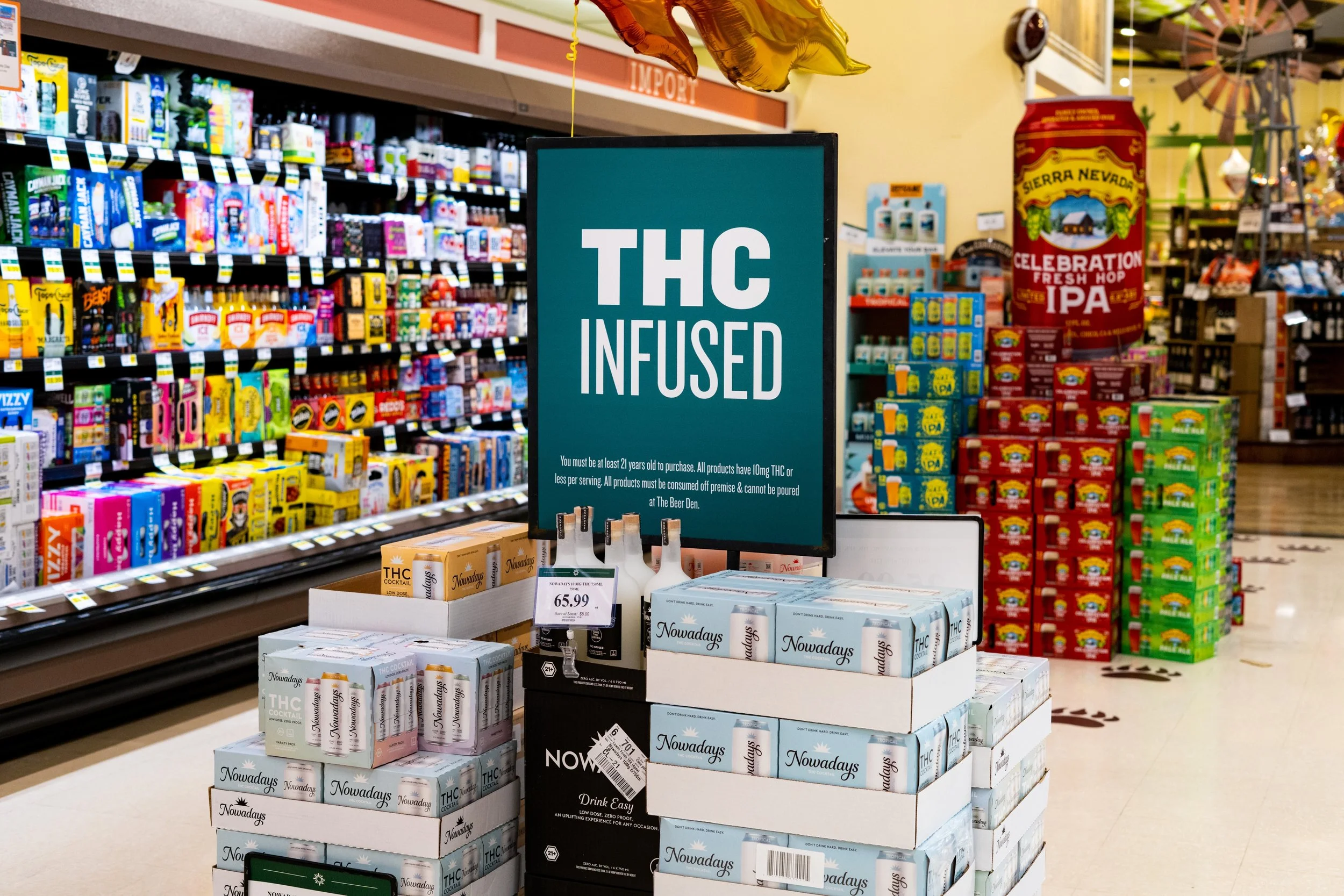
It also left the country with two versions of the same problem. One version became the caricature everyone loves to cite, the gas-station gummy with candy branding and no meaningful guardrails. The other version looked more like adult retail trying to grow up. Mature operators saw consumer demand and tried to meet it inside channels that can actually be governed, with testing, labeling, dosing, and packaging rules that resemble what a modern market deserves. Hemp-derived beverages are the cleanest example. They sit in places where IDs can be checked consistently, products can be pulled quickly, and a state can write rules that hold.
Nobody serious argues the current state of play is durable or sufficient. The question is what happens while the federal government decides how to repair the 2018 definition. States were forced to choose between pretending the category did not exist and governing what was already in commerce. Many chose governance, and even the bans required governance. A ban still has to define the product, assign jurisdiction, authorize inspections, and survive a hearing.
Once intoxicating cannabinoids show up in liquor stores, gas stations, and grocery aisles, the job changes. State government has to govern a psychoactive consumer product in the same places it governs alcohol and tobacco. The questions are basic and unforgiving: who owns the category, what counts as lawful, where it can be sold, what safeguards apply, and what enforcement looks like when the supply chain is real and the market is already in motion. Silence still functioned as a choice.
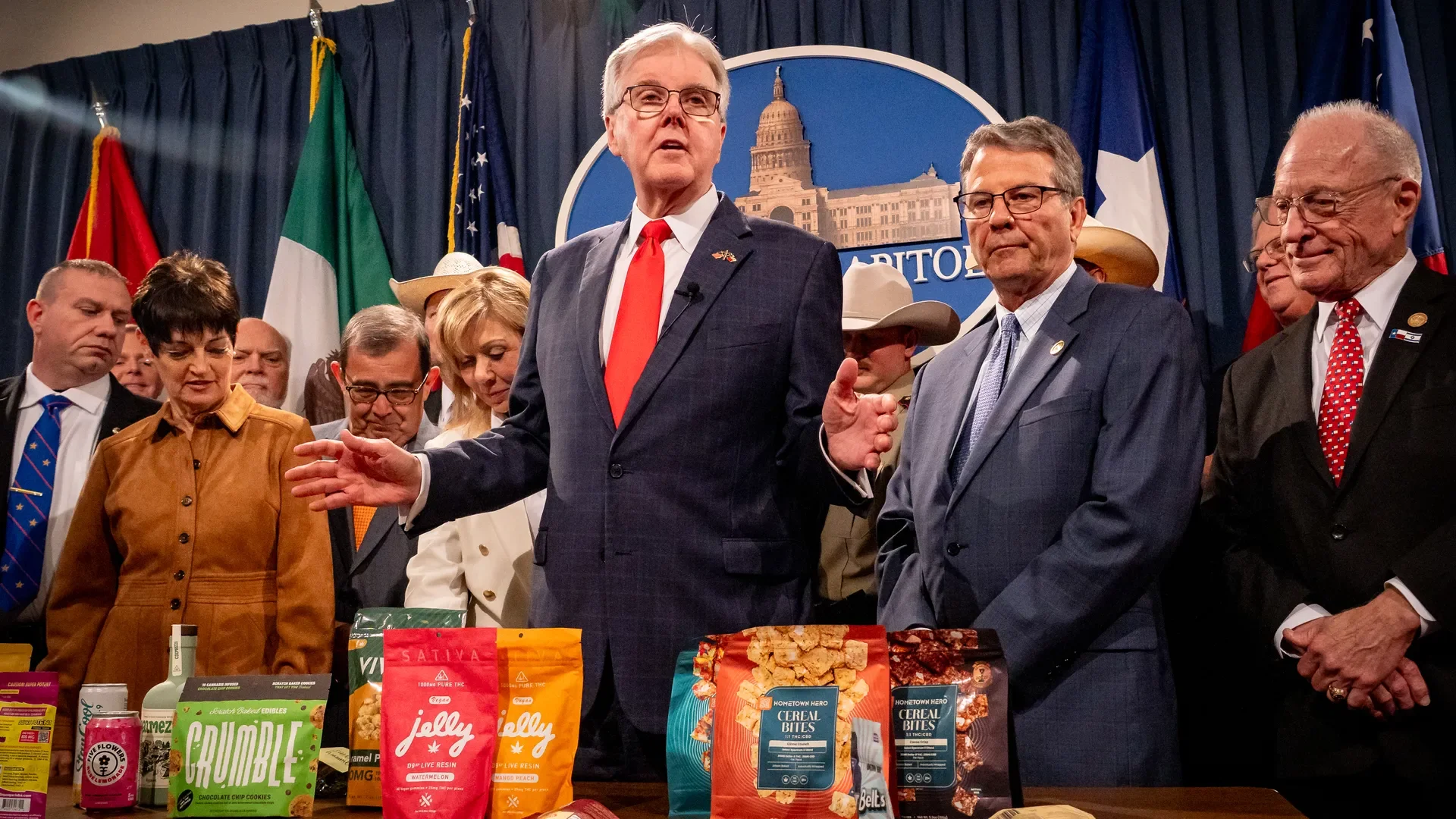
Photo: Sara Diggins/Austin American-Statesman via Getty Images
Most states responded in two tracks. One track was public, built for the cameras. Governors held press conferences with tables of cartoon-candy packages and warnings about “kids’ products,” as if indignation could do the work of regulation. The other track was administrative. Agencies had to decide who had authority, how to test products, how to write potency rules that survive hearings, and how to enforce age gating and labeling in ordinary retail. The public track grabbed headlines. The administrative track determined outcomes.
Those operational questions came fast, too. Which agency can inspect a grocery shelf, pull a product, and issue a stop-sale order that survives a hearing. Who controls lab standards, sampling protocols, and chain-of-custody when product moves through distributors and third-party warehouses. What age gating means outside dispensaries, where IDs are checked inconsistently and enforcement already strains under alcohol and tobacco. How to write a potency standard that can be measured, explained to a judge, and understood by a clerk at a register. The answers decide whether the state is running a program or reacting to a market that already learned the rules.
The word “loophole” has done real damage to the quality of this debate. It gets used like a moral verdict. It becomes shorthand for bad faith and a substitute for governance. Closing a loophole is a legislative act. Governing a category is a long campaign of definitions, inspections, penalties, and funding. States have largely aimed their legislative efforts at the worst expression of the loophole, the products designed to exploit ambiguity, skate past safeguards, and land in the broadest retail footprint with the fewest consequences. Those products deserve enforcement against standards, and the standards should be real enough to hold up on Monday morning.
A meaningful number of states chose the harder route and built systems.
Some moved intoxicating hemp into cannabis regulation, where the state already knows how to police intoxication. Michigan is a clean example: intoxicating hemp cannabinoids are treated as marijuana, sales stay inside licensed facilities, and testing and labeling run on familiar rails. Other states built the category through alcohol machinery, where the state already knows how to police mainstream retail. Tennessee moved oversight to the Tennessee Alcoholic Beverage Commission and Department of Revenue, built licensure across the supply chain, imposed serving and container limits, and defined total THC to include THCA. Still others drew hybrid lines and backed them with penalties that can be enforced. Colorado split oversight based on intoxication risk and anchored the technical definitions that make enforcement possible.
These frameworks differ, but they simultaneously share a governing premise that matters. Intoxicating cannabinoids can be treated as a regulated consumer product, with rules that an inspector can enforce and a judge can sustain. Someone has licensing authority. Someone owns lab standards. Someone defines potency in a way that can be measured. Someone decides what happens when a product crosses the line.
That premise carries economic weight as well as public health weight. Once a state builds a real framework, it creates a predictable channel. Retailers make stocking decisions. Labs invest in capacity. Regulators hire staff and build inspection routines. Legislatures attach taxes and fees to fund the work. States did not only ban bad actors. Many also built infrastructure, guardrails, standards, and revenue tied to the category. That revenue is not a celebration. It is the fuel that allows enforcement to be more than a press conference.
Tennessee’s intoxicating hemp tax revenue reached $11.3 million in FY24 and $14.5 million in FY25 through April, paired with reported sales volume of $245.4 million over a recent 12-month period. Minnesota’s program generated $11.5 million in 2024 with reported market volume of $145.1 million over a recent 12-month period. Those figures are a governance argument. Consumers rewarded structure. They bought regulated products in regulated channels, and the resulting revenue helped states pay for oversight.
Congress is now poised to change the definition underneath those systems.
The federal hemp rewrite shifts the definition to total THC, counts THCA, caps finished products at 0.4 mg per container, and excludes synthetic or converted cannabinoids. States that built programs around 2 mg, 5 mg, 10 mg, 50 mg, or 300 mg ceilings now face a reclassification event. The mismatch is not subtle. Virginia exceeds the cap fivefold. Colorado’s framework yields 6.25 to 8.75 mg per container even under tighter configurations. Tennessee’s 300 mg maximum exceeds it 750 times.
This is categorical misalignment. It is not sustainable.
The debate tends to degrade here, though. One side reaches for slogans. Another treats it as a pure lobbying fight. Everyone else drags it back into the federal marijuana stalemate, as if that analogy explains the operational problem sitting in front of state governments.
The federal government has plenty of authority here. Congress can absolutely regulate this market under the Commerce Clause and federal law can override conflicting state rules. What Congress cannot do is draft state agencies into federal service. States can decline to enforce. Businesses still carry the federal risk, even when state law says otherwise.
The hemp rewrite also avoids the clean fight. It changes the federal definition and leaves states to argue about consequences, which means the conflict will not arrive as a clean preemption clause that everyone can read and litigate on day one. It will arrive through implied preemption fights, definitional scope disputes, and dueling interpretations of the Farm Bill’s anti-preemption language. Uncertainty appears to be the operating condition.
Legal uncertainty matters, too. But it still misses the main point. The main point is what happens to states that built frameworks in good faith and funded enforcement with the expectation that their rules would have stable footing.
States built legitimacy on an implied bargain. The category would exist inside enforceable guardrails. Agencies would police it. Legislatures would fund it. Consumers would get something sturdier than the next headline.
A federal definitional contraction that collapses state programs without a transition path and without a workable mechanism for lawful state regulation punches through that bargain. It recasts state governance as provisional even when it has been serious. That message does not stay confined to hemp. It seeps into every adjacent space where states are expected to build systems while Washington debates definitions.
“States demonstrated willingness to oversee this category and an ability to do it. Consumers rewarded that structure with sales and revenue. ”
Here is the reasonable federal posture, even for lawmakers who dislike intoxicating hemp. Respect the progress that states made. States demonstrated willingness to oversee this category and an ability to do it. Consumers rewarded that structure with sales and revenue. A federal rewrite that tightens the definition without room for orderly state administration will not solve the problem. It will scramble it. It will push demand into less governed channels, strand state investments, and teach the wrong lesson about what serious state oversight earns.
Congress can close the loophole. Congress can also decide whether state governance counts for anything when it is done well.
Washington is about to decide whether that work mattered.