What If Bourbon Couldn't Leave Kentucky?
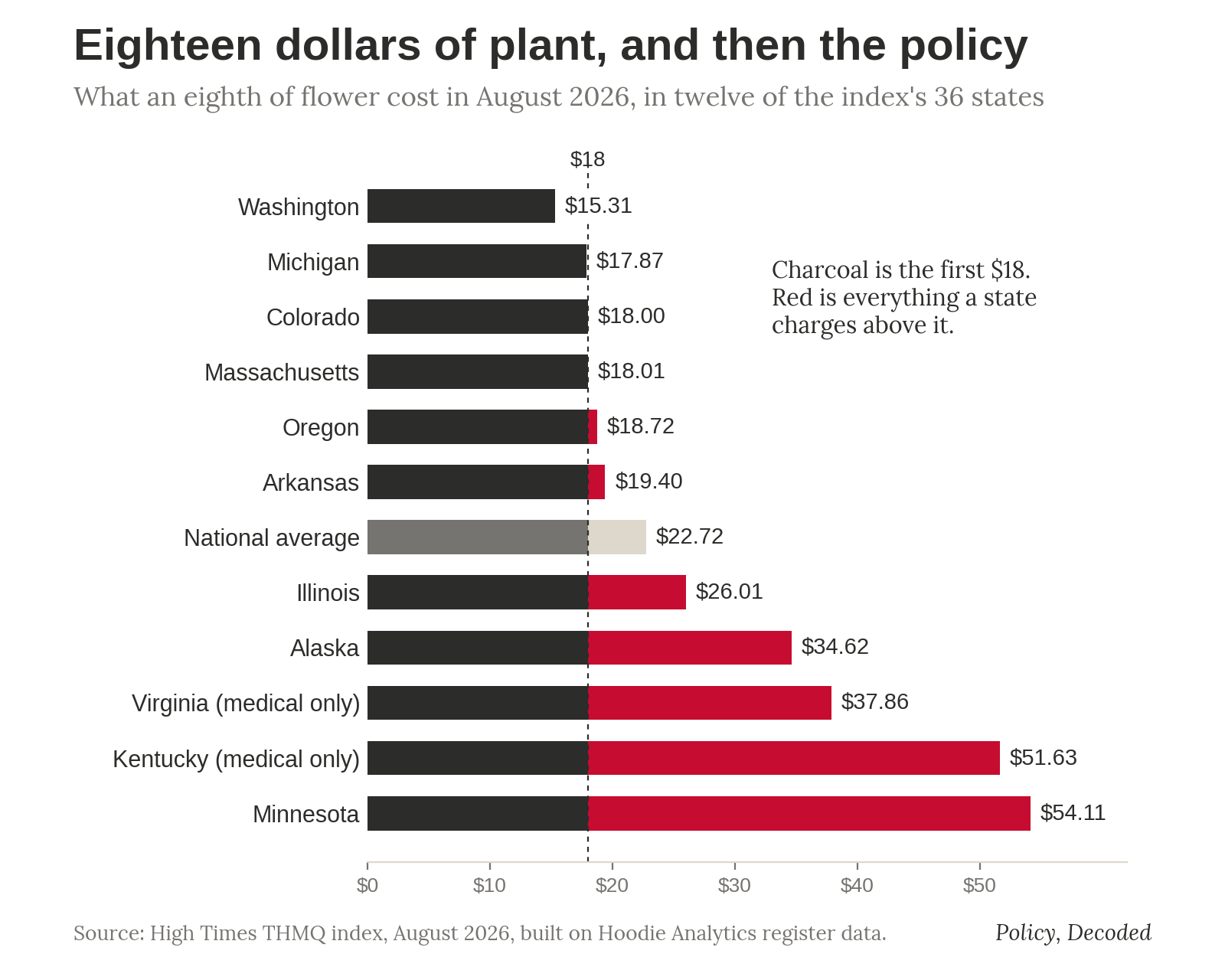
High Times brought back its old price index this month, rebuilt on register data that Hoodie Analytics collects from about 12,000 dispensaries, and the first full read of it landed Wednesday. An eighth of flower cost $15.31 in Washington in August. In Kentucky it cost $51.63, and in Minnesota $54.11. That is the same product, sold legally, in the same month, at three and a half times the price depending on which side of a line you happen to be standing on. Kentucky's program is medical only, so the $52 is what a patient pays, out of pocket, because no insurer covers it.
I want to explain where that gap comes from, because I think it is the most important thing about cannabis policy that sometimes gets lost on consumers, patients, and importantly, journalists.
Start with a bottle of bourbon. Every state handles liquor its own way. Virginia owns the stores and New Jersey licenses private ones. Pennsylvania still collects an 18 percent tax it created to rebuild Johnstown after a flood in 1936. For all of that, when a Boston University team priced the same 74 brands across the state-run systems and the private ones, the state-run stores came out about two dollars higher on a twenty-eight dollar bottle. The widest gap they found between any two state-run systems was New Hampshire at $26 and Washington at $35.
Bourbon behaves because bourbon crosses state lines. A distiller in Kentucky sells into all fifty states at roughly one price, so by the time any state gets around to taxing that bottle or marking it up, the base price already exists. States are arguing over the last few dollars.
Now run it the other way. Suppose Congress said tomorrow that bourbon could no longer cross a state line. Buffalo Trace wants to keep selling in Massachusetts, so it has to build a distillery in Massachusetts, buy Massachusetts corn, fill barrels here and wait six years. Ten or twelve for the good stuff. Then it has to do that forty-nine more times. Most distillers couldn't, so they would license the name to a local outfit and hope for the best. Kentucky, which by the industry's own count makes about 95 percent of the world's bourbon, would be making bourbon for Kentuckians. Some states would decide the whole thing wasn't worth the trouble and go without. A bottle would cost $20 in one state and $70 in the next, and whatever was inside the Buffalo Trace bottle in Alaska, it would not taste like the one from Frankfort.
“A patient who finds a cannabis product that works for her pain in one state can’t count on finding it in the next one and can’t lawfully bring it along.”
That’s cannabis. Federal law forbids moving a gram of cannabis from one legal state to another, so every legal state has built a complete industry inside its own borders, with its own farms, kitchens, testing labs and stores, and none of it can be shared with the state next door. The largest companies have built what amounts to the same facility over and over, once per state. The jar in Illinois and the jar in Florida may carry the same name and the same logo, and what's inside was grown by different people from different plants under different rules.
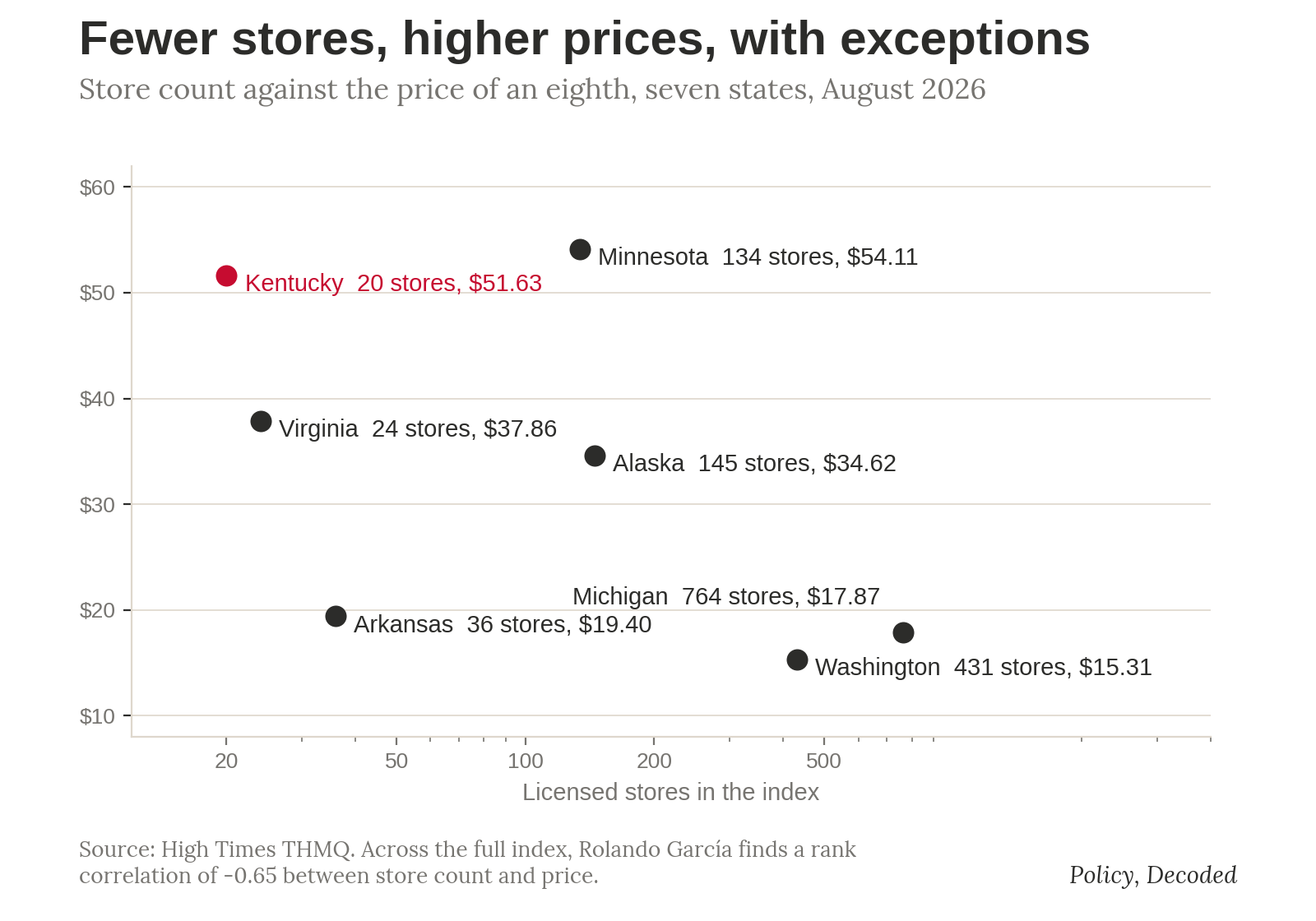
For somebody buying a gummy to help them sleep, that's a curiosity. For a patient it is something more. Your cholesterol pill is the same pill in Worcester as it is in Phoenix, and the co-pay is close to the same. A patient who finds a cannabis product that works for her pain in one state can't count on finding it in the next one and can't lawfully bring it along. Access varies the same way price does. Washington has 431 stores in the index. Kentucky has 20 for the whole Commonwealth, Virginia's patients have 24, and a handful of states have no program at all.
What sets the price inside the room
Once each state is a sealed room, what an eighth costs inside it comes down mostly to what it costs to grow and how many stores the state allowed to open. Rolando García, the economist who worked through the index for High Times, found that the number of stores tracks price more closely than anything else in the data. He is careful to say stores aren't the whole story, since taxes and growing capacity and the cost of getting anything to Alaska all matter, and he's right about that. But when he lined up medical-only states against adult-use states, the premium that patients pay turned out to be mostly a store count too. Medical programs are the most tightly licensed markets in the country, and their patients pay for it.
An eighth costs $17.87 in Michigan, $18.00 in Colorado, $18.01 in Massachusetts and $18.72 in Oregon. Those four states tax cannabis differently, grow it in different climates, regulate it through different agencies, and have never legally traded a gram with one another. What they have in common is that each of them, more or less, let the market fill up. And they have landed within 85 cents of each other.
That is how a commodity behaves, and ordinary flower is starting to look like one, even if the top shelf will always sell on the grower's name the way bourbon does. It can't trade like one yet, since a futures contract needs a product that can be delivered across a state line. But eighteen dollars is about as close as this country gets to a national price. It is what an eighth costs when a state lets enough people grow it and sell it, and whatever your state charges above that is, for the most part, something your state chose. It's one index and one month, and new markets always run high for a while. Even so, it is hard to look at Kentucky's $52 and see anything other than eighteen dollars of plant and thirty-four dollars of policy, paid by someone with a medical card.
When we were setting up Massachusetts, the arguments were about how many stores a town would accept and who got to open first. Those were the right arguments to have. They were also arguments about price, and I don't know that any of us understood that at the time.
Somebody pays for the shakeout
Every new market overbuilds. If the country legalized coffee tomorrow there would be a shop on every block by spring, and half of them would be gone a year later. That's ordinary, and it is what cannabis has done in every state that let it. Michigan's average ounce went from $350 at the end of 2020 to $60 this August. A gram in Massachusetts went from $14 when stores opened in 2018 to $4 this January.
When a coffee shop fails, the owner sells the espresso machine, ships the leftover beans to a roaster in the next state, and files for bankruptcy so the debts end somewhere. A cannabis grower has none of those exits. The inventory can't leave the state, federal bankruptcy court won't take the case, and on September 10th the Sixth Circuit threw out a $31.8 million verdict for a Michigan grower called Hello Farms on the ground that a federal court can't enforce a contract for adult-use cannabis.. So in a state that opens the doors, the shakeout lands on the people who built all that in-state infrastructure, and it lands harder than it would in any other business.
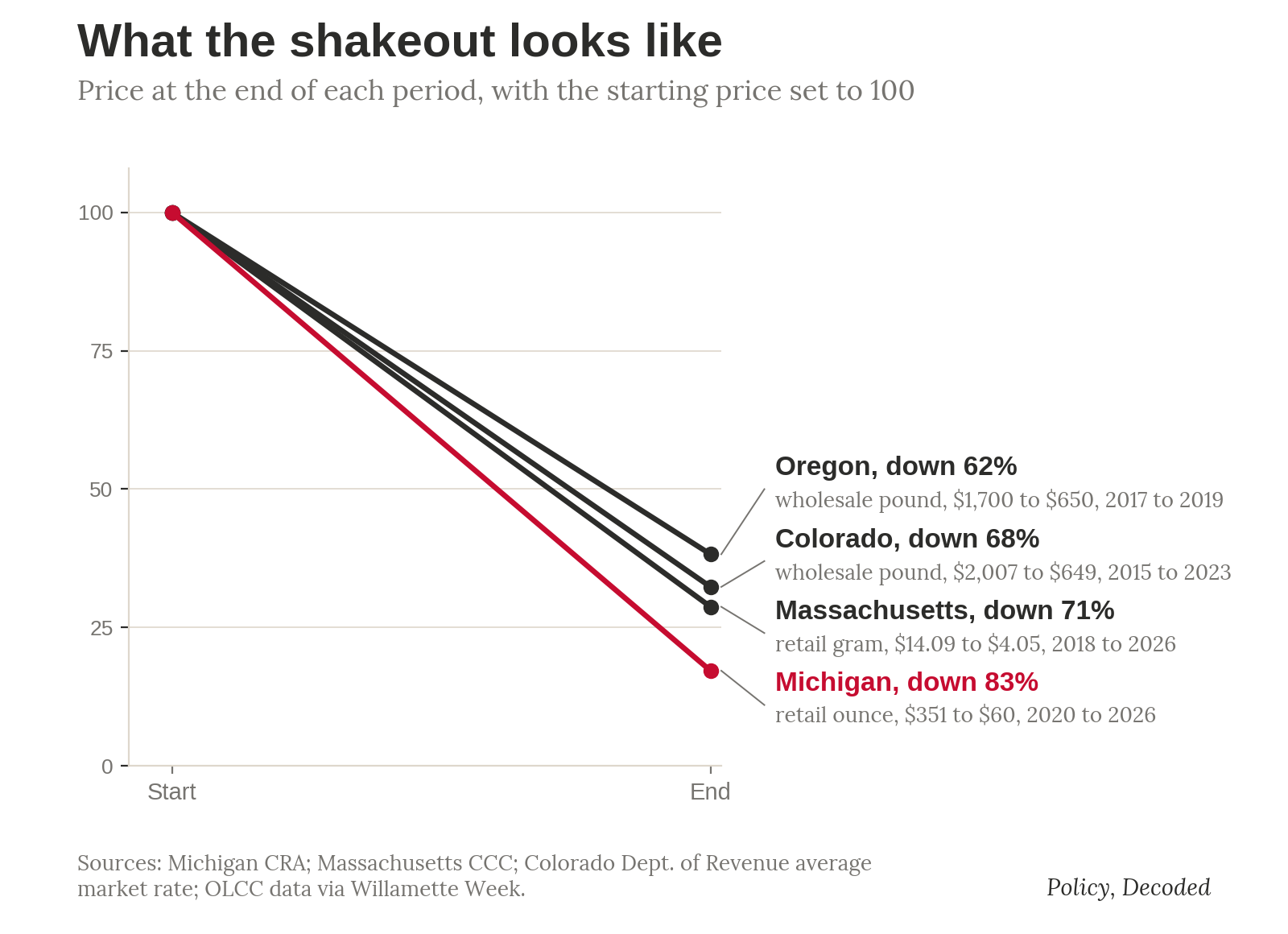
I used to point to Oregon as the cautionary tale, and that was lazy of me. Oregon's voters set no cap on licenses in 2014, and within a few years the state was growing twice what it could consume and wholesale flower had fallen from about $1,700 a pound to $650. That was a catastrophe for anyone holding inventory and a very good few years for anyone buying an eighth. The serious objection came from Oregon's U.S. Attorney at the time, Billy Williams, who worried out loud in 2018 that the surplus was heading east. Oregon's regulators answered that it was still sitting in their tracking system. I don't know which of them was closer, and it remains the best argument for a cap I've heard. Oregon got to a cap anyway, in 2024, ten years after declining one.
A cap moves the bill to the other side of the counter. The patient in Kentucky pays it, fifty-two dollars at a time, and some number of people who would otherwise buy legally keep their old dealer. A report the Maryland Cannabis Administration sent to the General Assembly's budget committees this March said as much, in careful language. Fewer licenses means less competition, which can mean higher prices, which may mean the legal market captures less of the total.
A cap also creates something an open market never does, which is a license worth owning for its own sake. Planet 13 paid $55 million in 2021 for a Florida medical license and nothing else. No stores came with it and no plants. Then Florida took applications for 22 more licenses, enough to nearly double the field, and in 2024 Planet 13 sold that same license for $9 million. A license like that is worth whatever the state's promise to keep the room small is worth, and Florida had just revised theirs.
Virginia is deciding this right now
Virginia opens adult-use sales on July 1st, 2027, with no more than 350 stores licensed before 2028. The Governor tried to make it 200 and the General Assembly put it back. The state's medical eighth runs about $38 today.
I don't think a cap is an illegitimate choice. Fewer stores are easier to inspect. A market that doesn't flood doesn't leave a field of failed businesses behind it, and there are real public health reasons not to want cannabis at Washington prices. A legislature can weigh all of that and decide the premium is worth paying.
The honest version of that decision would go something like this. We are capping stores because we want a market we can supervise, we accept that our patients and our adult consumers will pay more than they would next door, and we accept that some of them will keep buying from someone without a license. I've never seen a legislature put that in writing, though every capped state has made the trade.
My guess is that Virginia's eighth is still above $35 at the end of 2027. If it's under $30 by then, the cap matters less than I think it does.
What's holding all of this up
Every number in this piece depends on a border that no state capitol controls. Oregon, California and Washington have each passed laws allowing cannabis trade with other states the day the federal government permits it, and none has ever been used. April's order moving medical cannabis to Schedule III lets federally registered businesses ship to one another, but only within the limits of their state licenses, and state licenses stop at the state line. On September 10th a Michigan man named Kenneth Gay, turned down for licenses in Washington State and in Sacramento because he lives in Michigan, asked the Supreme Court to rule that states can't reserve their cannabis markets for their own residents. The Court told Tennessee exactly that about liquor stores in 2019. The responses are due October 15th.
Nobody can say when that border opens, or whether it should open all at once. While it has stayed shut, some forty states each stood up an entire industry, seed to sale, so that nothing would ever have to cross a line. Bourbon got to find its Kentucky, and cannabis never has, though Oregon passed that export law because it has a guess. Until the border moves, forty states will go on running forty complete supply chains, and a patient in Kentucky will go on paying $52 for what costs $18 in Michigan.
Links and Resources:
Price Data
High Times. Weed Prices by State 2026: What an Eighth Costs and Why, Rolando García's read of the August index, including state prices, store counts, and the comparison of medical-only and adult-use states. September 16, 2026. Trade press. The register data comes from Hoodie Analytics, a commercial vendor, under what High Times describes as an unpaid editorial partnership.
High Times. Trans-High Market Quotations, the live index and its downloadable price file, the source for the Massachusetts and Oregon figures.
Michigan Cannabis Regulatory Agency. Monthly statistical reports, average adult-use retail price per ounce. The December 2020 figure also appears in Cannabis Business Times. Trade press.
Massachusetts Cannabis Control Commission. Sales and Product Distribution, open data on average retail prices since November 2018.
Bourbon
Siegel et al. Differences in Liquor Prices Between Control State-Operated and License-State Retail Outlets in the United States, Addiction. 74 brands priced across 13 state-run systems and 50 license-state stores, with state averages in Table 3. 2013.
Kentucky Distillers' Association. Industry overview, the source of the 95 percent figure. Trade association. VinePair has questioned the number, which has gone unrevised since 2009.
CBS Pittsburgh. Alcohol Sales in Pennsylvania Still Being Taxed Stemming From Johnstown Flood of 1936, the history of the 18 percent tax. The statute is 47 P.S. § 795.
Tennessee Wine and Spirits Retailers Association v. Thomas, 588 U.S. 504 (2019), striking a durational residency requirement for retail liquor licenses.
Oregon
Measure 91, the Control, Regulation, and Taxation of Marijuana and Industrial Hemp Act, as approved by voters. November 2014.
Oregon Liquor Control Commission. 2019 Recreational Marijuana Supply and Demand Legislative Report, supply at twice demand and the statement that unpurchased supply remained inside the tracking system. January 31, 2019. The retail price figure comes from the Commission's 2021 edition of the same report.
Willamette Week. Oregon Grew Record Amounts of Recreational Cannabis in 2019 But Wholesale Prices Spiked Anyway, wholesale prices from mid-2017 through 2019, drawn from OLCC data. Portland, Ore., February 2020.
Billy J. Williams, The Oregonian. U.S. Attorney: A Call for Transparency and Action on Marijuana. January 11, 2018. His office's enforcement priorities statement followed that May.
Oregon Legislative Assembly. HB 4121 (2024), the permanent per-capita license caps, and SB 582 (2019), authorizing interstate agreements.
Florida
Planet 13 Holdings. Planet 13 Closes Sale of Planet 13 Florida, the $9 million sale. May 6, 2024. Company press release filed with Form 8-K.
Planet 13 Holdings. Form 10-K for fiscal 2024, the September 2023 impairment and the license's carrying value.
MJBizDaily. Report on Planet 13's $55 million Florida license purchase. 2021. Trade press.
Tampa Bay Times. Report on the April 2023 application window, the April 2023 application window and the 2017 law that ties license counts to patient counts. February 3, 2023. News Service of Florida reporting.
Florida Phoenix. State Announces Intent to Award 22 New Medical Marijuana Licenses, bringing the total to 47. November 27, 2024.
State Reports & Statutes
Maryland Cannabis Administration. Maryland Cannabis Industry Sustainability and Strategic Growth Report, on license caps, competition, consumer prices and legal market capture. March 31, 2026. Prepared for the Administration by Cannabis Public Policy Consulting and transmitted to the budget committees under the Joint Chairmen's Report.
Vicente LLP. Virginia Retail Cannabis Law (HB 30): FAQs on Adult-Use Licensing, Taxes and Key Dates, the 350-store and Tier V limits and the July 1, 2027 start. August 2026. Law firm client alert.
California SB 1326 (2022) and Washington SB 5069 (2023), which with Oregon's SB 582 authorize interstate cannabis agreements once federal law allows them.
Federal Law & the Courts
Department of Justice. Attorney General Order 6754-2026, 91 Fed. Reg. 22,714, the Schedule III order, including the transfer provision and the Single Convention quota language. April 28, 2026.
Hello Farms Licensing MI, LLC v. GR Vending MI, LLC, No. 25-1759 (6th Cir. Sept. 10, 2026). Opinion. The defendants are Curaleaf subsidiaries.
Marijuana Moment. Supreme Court Asked to Overturn Marijuana Business Licensing Laws That Favor In-State Residents, on Kenneth Gay's petition, No. 26-343. September 2026.
From Policy, Decoded
How to Be Heard, our guide to writing a comment that works, free with five referrals of Policy, Decoded.
Cannabis and hemp comment deadlines and effective dates, tracked daily at homegrown-group.com/deadlines.