
The Power of Presence: A Guide to Policy Advocacy
Washington spent this week fighting over twenty-nine days around the holidays.
The federal hemp ban takes effect November 12th. The Senate's stopgap funding measure moved certain provisions to December 11th instead, and for four weeks of runway, the following transpired this week: Thirty-five state and territorial attorneys general signed a letter. Nearly one hundred organizations signed another one going the other direction. The National Restaurant Association wrote to leadership. Dr. Oz, now the administrator of Medicare and Medicaid, urged senators to leave the extension alone because his agency is studying the products. Senators Ted Budd and Pete Ricketts and others filed an amendment to strip the extension and took the floor to argue for it. President Trump called Budd personally to try to talk him down. Groups that have spent a decade opposing cannabis legalization found themselves on the same side of the vote as licensed cannabis operators. The amendment was ultimately tabled 61 to 32 in the small hours of Saturday morning, the funding bill passed and advanced to the House, whose own version says nothing about hemp, and the Senate then left for a five-week recess.
That was the view from the top. The view from the ground was different. Operators who had never called a congressional office were looking up who their senators are. Compliance managers drafted their first letters to Washington. Companies re-engaged lobbyists they had cut loose two budgets ago and redeployed them on the fly to talk about product lines, payroll counts, and testing regimes, because the vote was days away and there was no time to do it properly. The action centers lit up with a hundred variations of call this number and say vote yes…or was it no? An entire market got a crash course in civics this week, and I mean that as an observation, and mostly as a compliment.
Nobody collects a hundred signatures in a week by accident. Scrambles like that run on missed dinners and phone calls at strange hours, and I have been part of enough of them to respect the people on every side of this one.
Here is the thing about a crash course, though. It is still a course. Nothing anybody learned this week was wasted, and nearly all of it arrived late. The fire drill itself was inevitable. The calendar guaranteed this one, and it has already scheduled the next one for December. For the legislators, regulators, and staff on the receiving end, the pace was not even unusual; vote yes, vote no, educate me by noon is roughly every week of their working lives. But a fire drill only helps the people who have practiced it, and the operators who moved fastest were the ones who already knew the building. They knew their senator's name before Monday. They knew which staffer picks up. Their lobbyist did not need the industry explained at midnight. The week rewarded the boring work done in the quiet years. It always does.
This week was the Super Bowl. A federal ban, presidential phone calls, a floor vote in the wee hours. The same game runs every day with nobody watching, in state houses and city halls, where a committee decides which hemp bill gets a hearing and a zoning board decides whether your dispensary sits five hundred feet from a school or a thousand as the crow flies. Those rooms produce most of the rules you will actually live under, and they are far easier to walk into than anything in Washington. Commercial tax rates, water bills, and special permits are more routine than dose limits or qualifying conditions.
What stood out to me, though, was the arithmetic underneath it all. The clause that produced this entire week was written in 2018. One line in the Farm Bill, defining hemp as cannabis with no more than three tenths of one percent delta-9 THC on a dry weight basis, measured in the plant rather than in the product somebody eventually buys. One isomer, one measurement point. Everything since has followed from it. The gas station gummies, the THCA flower, a market north of twenty billion dollars, the emergency room numbers on the Senate floor, and now a fight over twenty-nine days.
Watch this stuff long enough and a rhythm begins to take shape. Months where rulemaking amounts to a posted agenda and an empty sign-in sheet, then a short violent week where it is standing room only and the calendar dictates terms. The empty stretch produces the crowded one. That is the metabolism of policy, and nobody chose it. The pace comes from fiscal years and election calendars and whichever vehicle happens to be moving.
I have been lobbied a great deal in my career from the other side of the table, by people who were really good at it. Many of those relationships outlasted the matters that introduced us. In fact, I am a registered lobbyist in Massachusetts myself, and this very publication comes from a consulting practice that advises businesses on precisely this work.
So take it from somebody with an obvious commercial interest in the professional version of advocacy, who is telling you anyway that the professional version is not the most powerful.
The most effective advocate is usually the person who is actually affected. Not their association. Not their attorney. Not me. Them.
People have been paid to persuade me for most of my career, first when I was a legislative staffer, then an assistant treasurer, and eventually the founding director of a brand-new regulatory agency, and the good ones ran the same play in all three rooms. Their position was well constructed, the numbers had been confirmed, the ask was calibrated to what my office or agency could actually deliver. The person delivering it would also be back in a few weeks about something else, which kept them honest. It is an important cog in the system, and plenty of good law and regulation gets made exactly that way. Behind the best of those lobbyists there was usually a trade association, and associations do things no individual can, including tracking calendars in forty states and activating a member in Ohio at eight in the morning when a vote gets scheduled for noon.
But a well-made argument slots into a category. It joins the pile of well-made arguments. The staff attorney writing the bill summary or draft regulation records its substance, and nothing else survives.
An affected person is harder to just file away. They show up with something that happened to their own business, and the detail is usually stranger than anything a professional would have chosen to lead with. It lodges. Months later, when a commissioner is weighing whether a provision is workable, the association's economic analysis is somewhere in a binder. The grower who explains what it costs them to preserve 90-days of video recording sticks with you, though.
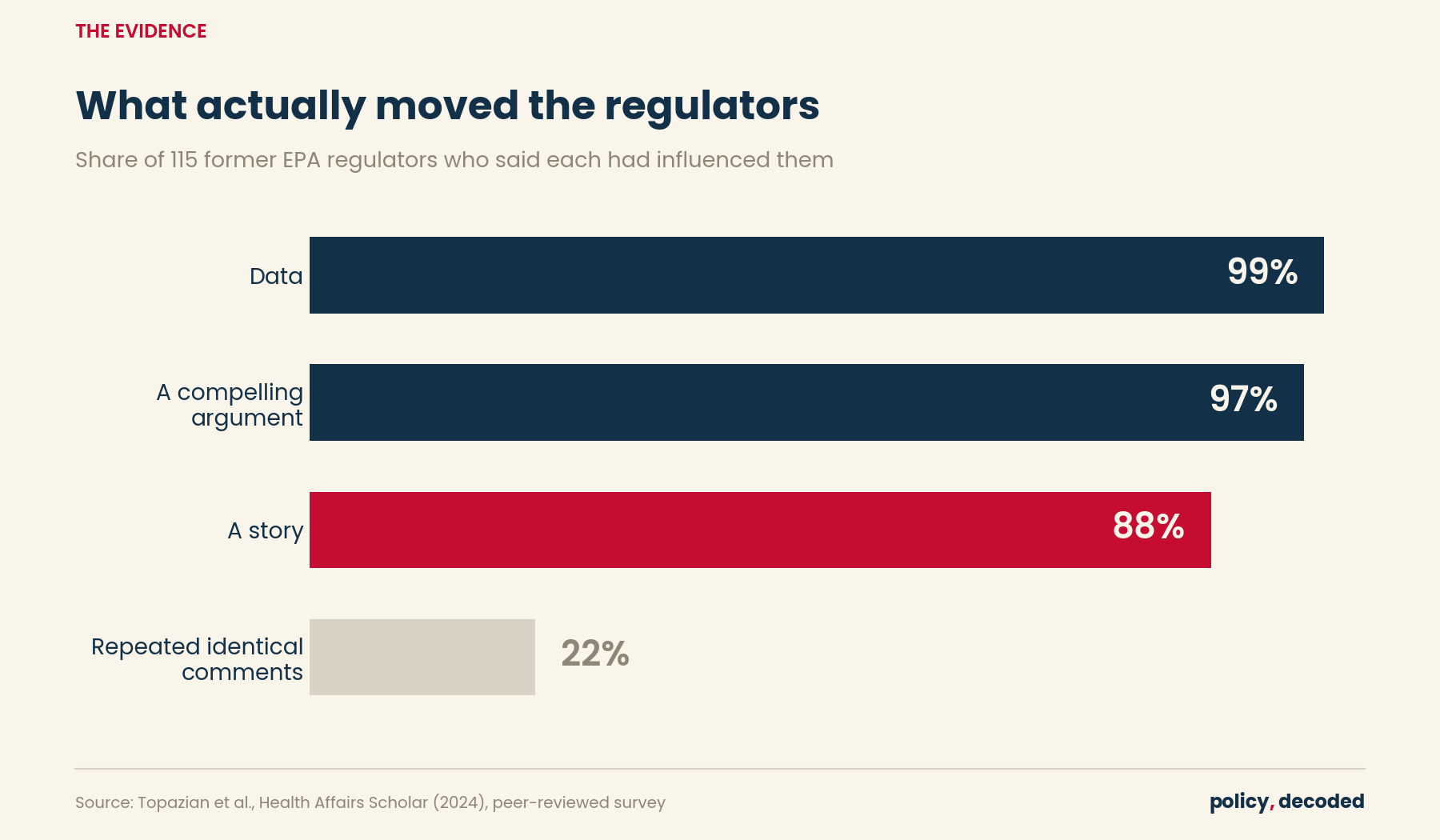
The research on this surprised me, because it turns out authenticity is measurable. A peer-reviewed survey asked 115 former EPA regulators what had influenced them. Data, ninety-nine percent. A compelling argument, ninety-seven. Storytelling, eighty-eight. Repetition of identical comments, twenty-two.
Look at that eighty-eight again. These are career bureaucrats at an agency that runs on quantitative analysis, and nearly nine in ten admitted a story moved them. They rated data higher, sure. The person who brings both at once is close to unanswerable, and the only person who can bring both is the one it happened to.
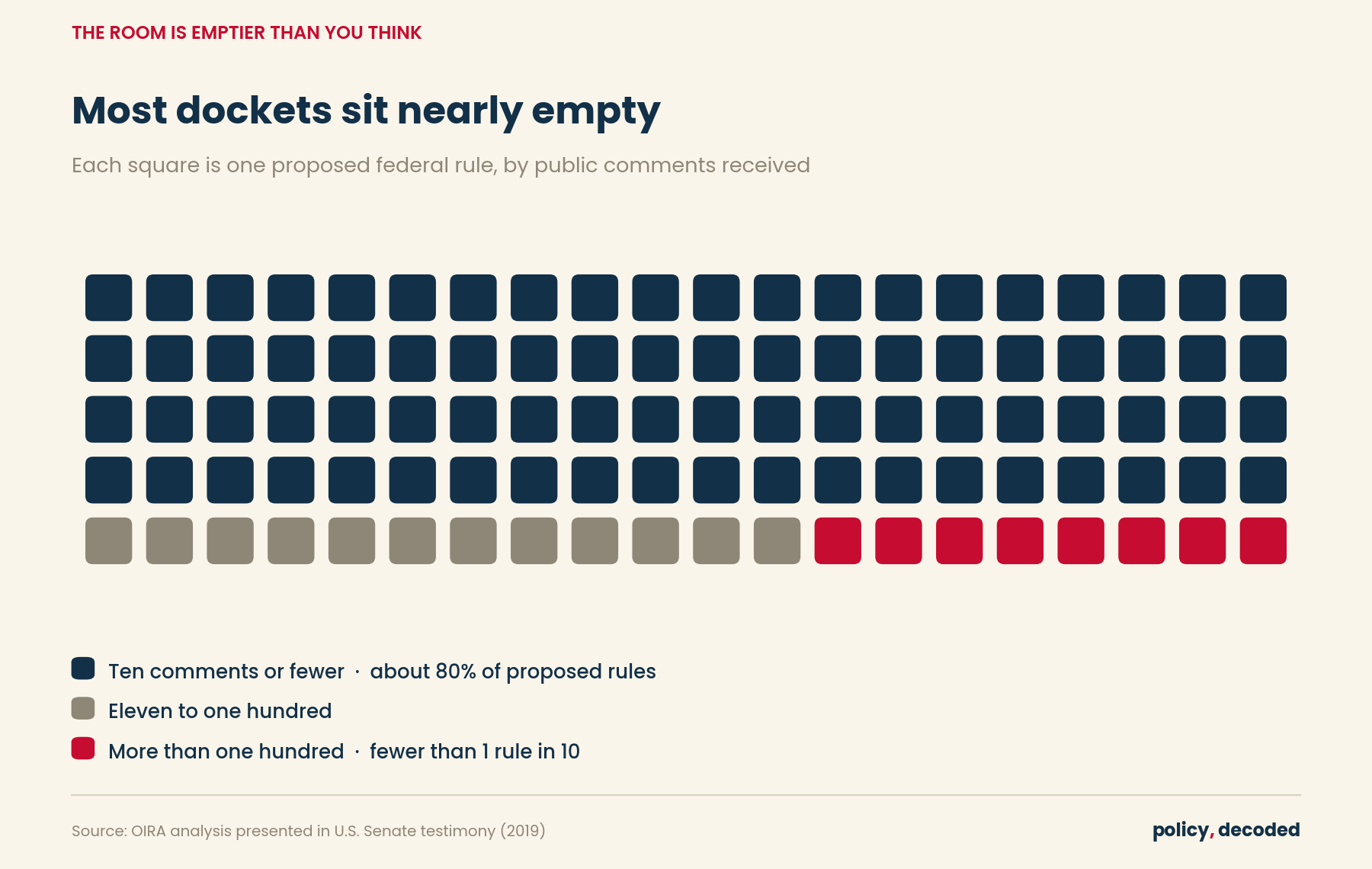
Now for the numbers I lean on hardest. About eighty percent of proposed federal rules receive ten comments or fewer. Ten. Fewer than one in ten draws more than a hundred. The crowded hearing you are picturing is the rare exception. Most dockets sit nearly empty, and one serious letter, all by itself, is a real share of everything the agency will read.
And when agencies move, they move on specifics. One study followed more than seven hundred issues raised across a dozen major federal rules. Agencies changed something on four in ten of them, requests to clarify language fared best, and whether one commenter raised an issue or a hundred did made no measurable difference.
So does volume matter at all? It does, for different work. A campaign that produces thirty thousand comments shows a legislature how broad the feeling is, gets a member's attention, tells an agency the room is watching, and keeps a coalition mobilized between fights. Those are real jobs. They are just different jobs from the one your own letter does.
Twenty-two million comments were filed on the FCC's net neutrality repeal. Roughly six percent were unique, and the New York Attorney General later concluded nearly eighteen million were fake, millions of them filed under the names of real people who had never seen them, including some who had been dead for years. The EPA says it plainly in its own guidance: the comment process is not a vote, and one well-supported comment is often more informative than a thousand form letters.
The action center with the “submit” button shows scale. It is, by design, incapable of showing the detail nobody else would have. An association that sends the form letter and separately helps three members write their own has used the moment twice.
Timing is where good intentions go to die. A researcher interviewed participants in Colorado's Marijuana Enforcement Division rulemaking and asked them to rank the stages of the process by usefulness. Formal hearing testimony finished dead last. One participant said it did the least good because by then it seemed too late, and that participant was exactly right. The rules had been worked out months earlier, in informal workgroups, by whoever bothered to show up.
This is the uncomfortable part of the advice. Getting involved early is easy because nothing feels urgent yet. The chairs are empty, the staff has time to talk, and a good suggestion can still change what gets proposed. Getting involved late is hard because everything feels urgent at once. By then you are one voice among hundreds, asking a room to undo months of work in an afternoon. The room cannot do it, and people walk out convinced the whole thing was rigged. Nothing was rigged. The work was simply finished.
There is a good argument against all of this.
The quiet meetings I just told you to attend were mostly full of people whose job it was to be there. I know because I ran hundreds of them. A company with forty employees can spare somebody on a Thursday morning. A shop with four cannot, because everybody is busy growing, packaging, labeling, and doing. A patient on disability is not giving up a day's pay to testify about a draft rule that might change anyway. So telling people to show up early is, in part, telling them to be better resourced, and the process quietly sorts by who has slack in the week.
For the person who cannot spare the Thursday, the bar is lower than it looks. A letter written at a kitchen table, naming the provision, saying what it does to you and what it costs, what it risks, counts as full participation. It also quietly preserves legal arguments your lawyer may want someday, since courts are generally closed to objections nobody raised during the comment period. On the evidence above, it is the kind of filing agencies actually act on.
What about relationships? They matter enormously, but the word usually implies access, and I mean something duller and more available than that. Marc Galanter wrote the definitive study back in 1974, asking why certain parties keep winning before the same institutions. His answer was that repeat players behave differently. They will take a worse result today to protect their standing tomorrow, because they are playing the next eleven rules, and they know it. The classic lose the battle, but win the war.
That describes a licensee. It also describes a patient advocate who has come to four straight meetings, and a farmer who called the same staff attorney twice and was straight with him both times. Standing gets built by returning, and by being reliable about facts. Agencies compare your figures against other filings and against their own data, and an exaggerated number is usually identifiable. Same with a downplaying one. Get caught once and everything you file afterward starts at a deficit. The most valuable thing anyone can do in a comment letter is give the accurate number in the place where a larger one would help them more.
Former Speaker Tip O'Neill, of the “All Politics is Local” fame, lost the only election of his life in Cambridge in 1935. A neighbor, Elizabeth O'Brien, told him afterward that she had voted for him anyway, though he had never asked her to. He had shoveled her walk for years. She still wanted to be asked. Both halves of that are the lesson. Showing up for years without ever making a specific request is a hobby. Making the request without having shown up is a cold call.
The map matters as much as the manners and candor, too. Part of the quiet-year work is knowing who represents you, who regulates you, and who staffs them. The other part is knowing who sits on the other side. Some hemp businesses in North Carolina absorbed a hard version of that lesson this week, watching their own senator lead the charge against their shelf space. Minnesota saw theirs go to bat for them. Better to learn where your elected stands in March than in August. A persuadable office takes a phone call and a good letter. An opposed one takes a campaign, and campaigns run on a different playbook and a much longer clock. Either way, you want to know which race you are in before the vote gets scheduled.
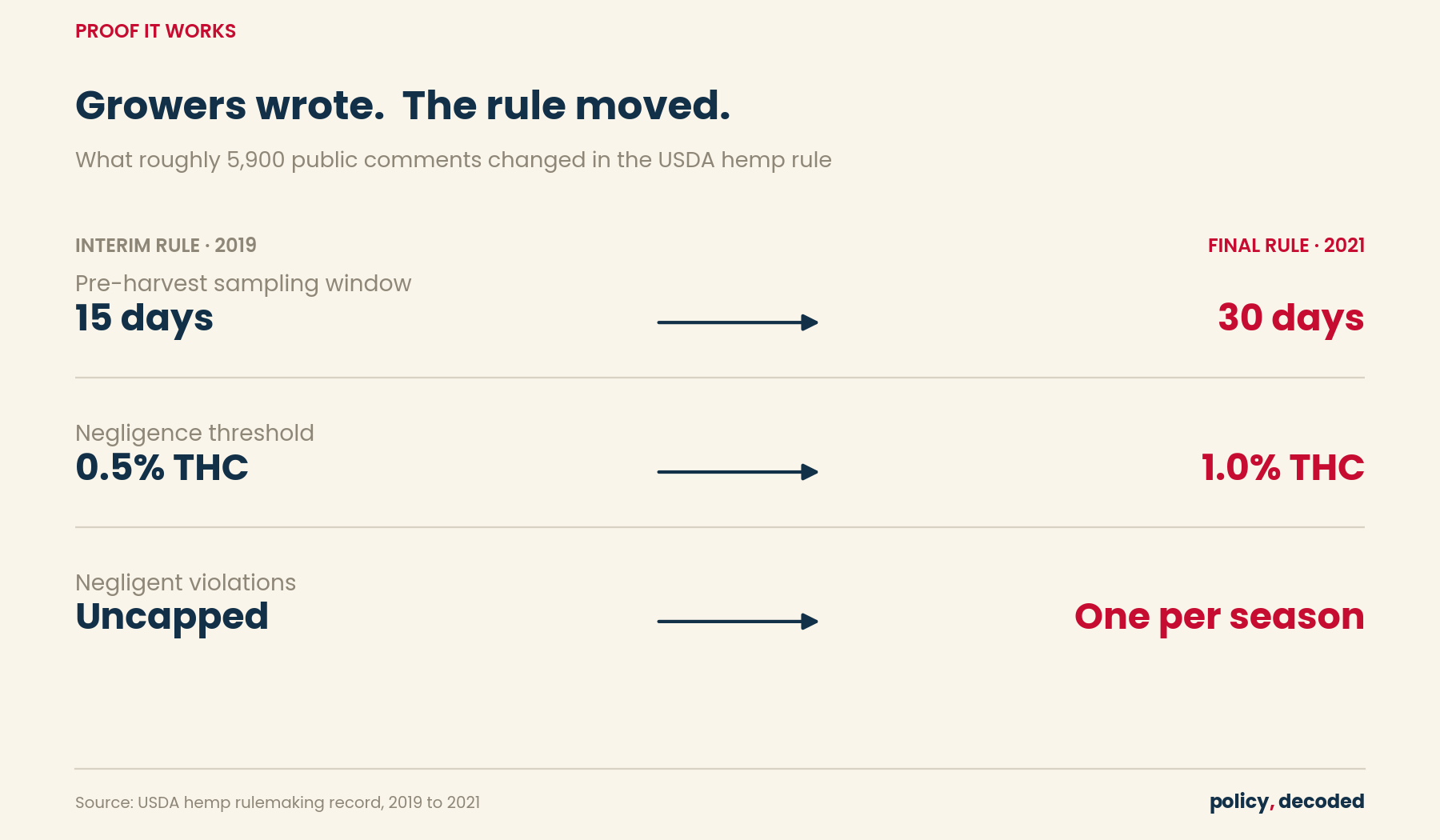
Does any of this actually work in cannabis and hemp? It already has. Roughly 5,900 comments on the USDA's interim hemp rule impacted the final outcome. The pre-harvest sampling window stretched from fifteen days to thirty, the negligence threshold rose from half a percent THC to a full percent, and negligent violations were capped at one per season. Growers wrote letters with numbers a USDA economist could verify, and the rule changed.
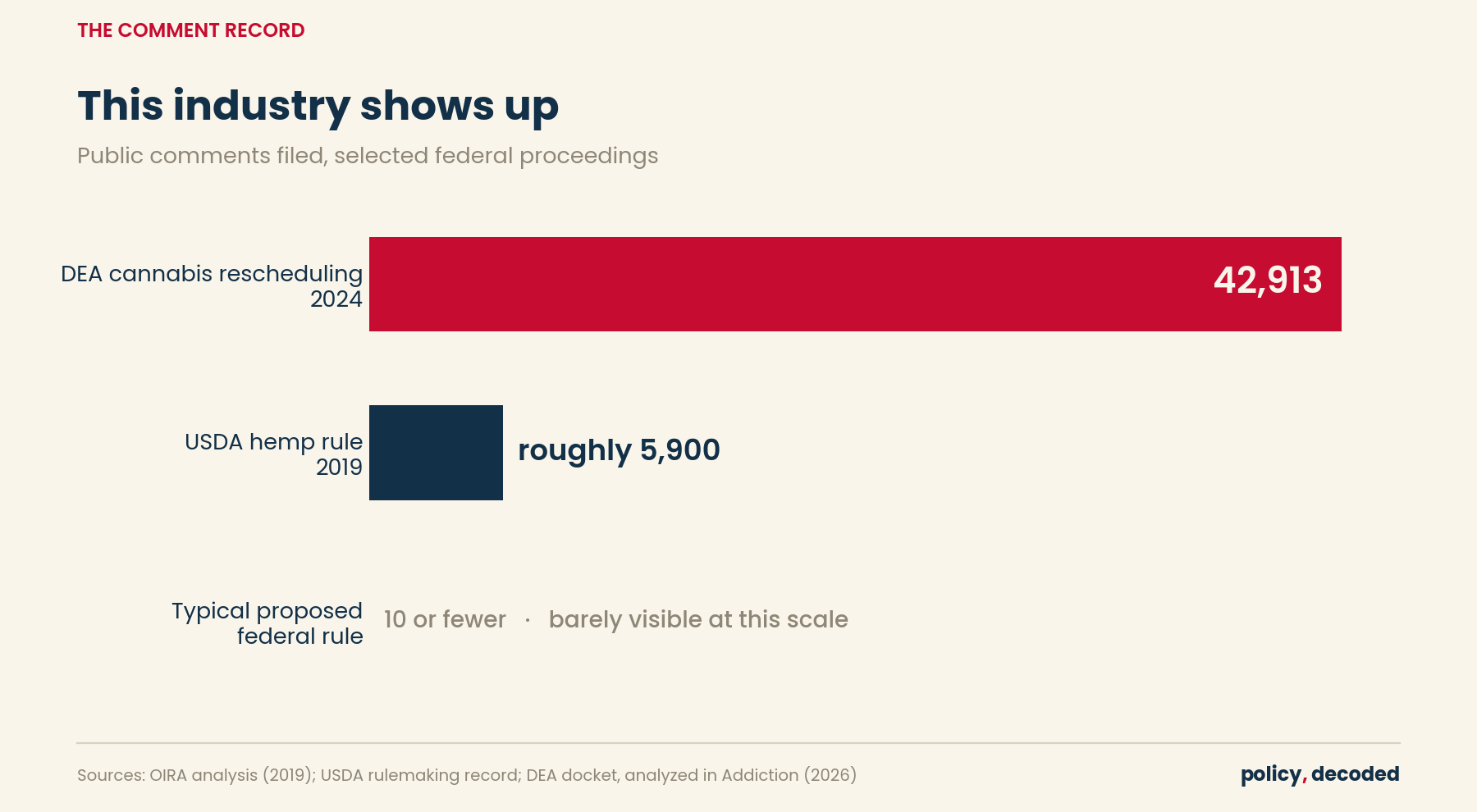
Rescheduling sits at the other end of the scale. Nearly 43,000 comments landed on the DEA's proposal to move cannabis to Schedule III, roughly four thousand times the traffic of an ordinary docket, and the volume helped force a full evidentiary hearing. The scheduling question itself remains open, because in a proceeding that political, executive branch dynamics run over the comment record, and the final call belongs to an administrator and, after that, an appeals court.
Remember, too, that regulators are underfunded, routinely blamed, and frequently right about things an industry recognizes two years later. The comments that change rules are the ones that explain a life or a business clearly, hand the agency information it did not have, and make the correct decision an easy one to reach.
At THC Group, we have been building a guide on advocacy. It is called How to Be Heard, and it has an annotated model comment, a map of where in a rulemaking your effort actually pays, a routing guide for matching a problem to the office that can fix it, and a checklist to run before filing. It is a free download once you refer Policy, Decoded to five people, and I prefer to think of that as advocacy practice. A specific ask, made to people you know, with something real offered in return. That is most of the curriculum right there. Your referral link is at the bottom of our daily emails, and I would rather the guide be used than admired.
The other unknown is timing, and we solve that one, too. Every cannabis and hemp comment deadline and effective date we track lives at homegrown-group.com/deadlines, updated daily, and the countdown block in each morning brief pulls from the same page. Between the guide and the calendar, the excuses are getting thin.
All of that is still the smaller half of this. The important part is for everyone who spent this week learning their senator's name: do not let the recess erase it. The office you called on Thursday answers the phone in September too, when nobody is calling and a staffer has twenty minutes and an open notebook. Somewhere right now a workgroup calendar has your state's next cannabis or hemp rulemaking on it, open and posted, and almost nobody will come, because nothing is on fire yet. That is exactly the window in which everything gets decided, and the next alarm is already on the calendar for December 11th, if the House is agreeable to extend twenty-nine days. A big if.
Go, if you can. Leave the association hat at home and go as the person it affects, with the address and the numbers and the specific Tuesday it went wrong. Say it to the staff attorney who will still be there in four years, after the commissioners have moved on. Leave an impression.
The professionals will be in the room regardless. We are paid to be there. You are the one they will remember when voting aye or nay.
Links and Resources:
Congressional Actions & Letters
Roll Call. Funding Patch Passes Senate to Head Off Fall Shutdown, floor coverage of the tabling vote and final passage. Washington, D.C., August 8, 2026.
Smart Approaches to Marijuana. 35 State Attorneys General Urge Congress to Reject Any Effort to Delay or Weaken the Hemp THC Ban, press release announcing the attorneys general letter. Washington, D.C., August 2026. SAM helped organize the letter and opposes the extension.
U.S. Hemp Roundtable. Nearly 100 Organizations Urge Senate to Preserve Hemp Ban Delay, coalition letter announcement. August 7, 2026. The Roundtable advocates for the extension.
News Coverage
Cannabis Business Times. US Senate Plans to Delay Ban on Intoxicating Hemp Products, continuing resolution coverage. August 2026.
Cannabis Business Times. 35 Attorneys General Tell Congress to Keep Hemp THC Ban Put, letter coverage. August 2026.
Marijuana Moment. GOP Senators Argue That Hemp Product Ban Should Take Effect As Scheduled, Raising Alarm About Kids' Access To THC, floor speech coverage. August 5, 2026.
Axios. Inside the GOP Hemp Wars, reporting on the presidential call to Sen. Budd. August 5, 2026.
The Hill. Senate Tables Hemp Amendment at Center of Funding Fight, Allowing One-Month Delay of Ban, vote coverage including the CMS administrator's statement. August 8, 2026.
The Hill. Senate Passes Stopgap Funding Bill to Prevent Shutdown Ahead of Midterms, passage coverage including Sen. Budd's floor remarks. August 8, 2026.
Marijuana Moment. Senate Votes To Delay Hemp Ban, Giving Lawmakers More Time To Craft Regulations To Keep THC Products Legal, vote coverage and hemp definition background. August 8, 2026.
Research & Scholarship
Topazian, R.J., et al. Understanding the Factors That Impact Federal Rulemaking, survey of 115 former EPA regulators. Health Affairs Scholar 2(10), 2024. Peer-reviewed.
Koski, W.L. Understanding Stakeholder Interests in Rulemaking Through the Lens of Private-Interest Institutionalism, qualitative study of Colorado Marijuana Enforcement Division rulemaking participants. Walden University Ph.D. dissertation, 2020.
Characterizing Public Comments via Regulations.gov in Response to Proposed Cannabis Rescheduling in the United States, content analysis of the 42,913-comment rescheduling docket. Addiction, published online April 24, 2026. Peer-reviewed.
Galanter, M. Why the "Haves" Come Out Ahead: Speculations on the Limits of Legal Change, 9 Law & Society Review 95 (1974).
Shapiro, S. Working paper coding issue-level outcomes across twelve major federal rules (2013).
Office of Information and Regulatory Affairs analyses of comment volumes, as presented in U.S. Senate testimony (2019).
Pew Research Center analysis of the FCC net neutrality docket (2017).
Government Sources & Filings
Office of the New York Attorney General. Fake Comments: How U.S. Companies & Partisans Hack Democracy to Undermine Your Voice, investigative report. New York, N.Y., May 2021.
U.S. Department of Agriculture. Establishment of a Domestic Hemp Production Program, 86 Fed. Reg. 5596 (Jan. 19, 2021), final rule.
Regulations.gov. How You Can Effectively Participate in the Regulatory Process, official commenting guidance.
Legal Analysis
MS Law Group. New Final Rule from USDA Relaxes Requirements for Hemp Farmers, analysis of changes between the interim and final hemp rules. 2021.
Market Data
Forbes. Senate Moves To Delay Federal Ban On Hemp THC Products, including industry market-size estimates. August 3, 2026. Market figures are advocate-cited and industry-generated.
From Policy, Decoded
How to Be Heard, our guide to writing a comment that works, free with five referrals of Policy, Decoded.
Cannabis and hemp comment deadlines and effective dates, tracked daily at homegrown-group.com/deadlines.