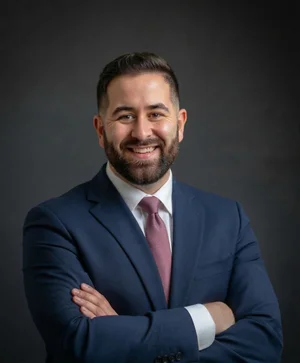
To The Class of Schedule III
To the cannabis industry, the graduating class of Schedule III: congratulations. I know how you got here, so before I say anything else, I want to look at who actually showed up.
Some of you are running on no sleep and somebody else's money, spending future earnings the way a college kid spends a loan refund, joyfully and with no plan whatsoever. Some of you bet the house to be in this room, the literal house, and you are going to be paying that back long after today is a photo nobody can find. Some of you transferred in last semester with an idea and not much else, and you do not yet know what you do not know, which is the most dangerous and the most enviable place a person can stand. Look at all of you in one place. Life is weird and funny and completely unpredictable, and nobody in this room needs me to explain that, because you have watched a single plant go from a felony to a pharmacy to a courtroom, sometimes inside the same quarter.
“You were patients and true believers and gas-station entrepreneurs and the people the law came for, and ten years ago most of you would not have crossed the street for each other.”
So look to your left. Look to your right. The person sitting next to you came up nothing like you did. Some of you came of age inside medical programs that exist only because a mother drove across a state line to buy oil for a kid who was seizing, then came home and spent five years fighting her own legislature. Some of you came in through the side door, the comma somebody found in the 2018 Farm Bill, and built a whole company in the space between two words. Some of you spent twenty years throwing rocks at castles, the advocates who got themselves arrested on purpose to drag the argument in front of a judge. And some of you never had to volunteer for it. You did real time for this plant, back when putting people away for it was the entire point of the law. The war on drugs was not an accident, and you were not caught by mistake. It was a policy, aimed with precision at Black and brown neighborhoods, and it worked exactly as it was built to. A decade later the same system that gave you the record handed you a social equity application and called it square, and you already know how much of that promise ever showed up. Now you are sitting in a cap and gown next to people who built fortunes on the same plant that took years off your life. I will not pretend I understand what that cost, because I spent those years behind a title and a desk while some of you spent them behind bars. You were patients and true believers and gas-station entrepreneurs and the people the law came for, and ten years ago most of you would not have crossed the street for each other.

Image Credit: Cleveland School of Cannabis
And what you have been to each other since is stranger still. You have gone from friends to competitors, from allies to enemies, and sometimes back again inside a single legislative session. Alcohol and hemp. Pharma and medical. The illicit market and the venture capital that came to buy it. Strange bedfellows who met in college. Now you are in the same room with your eyes pointed at the same future. Hold that picture. It is going to matter more than anything else I say.
I am supposed to stand up here and tell you the world needs you, that you are ready, that the future belongs to the bold. You have heard that one more than once this year, and you stopped believing it, which was the right instinct. So I will skip it. I used to be a regulator. That job does not let you say the hard thing plainly; you learn to talk in guidance and hedges. The best part of graduating is that I get to drop all of that. So here is the part the speeches leave out. What you picked up in April was a diploma, and a diploma is a receipt. It means you cleared the prerequisites and earned your way into an even harder room. It does not mean the world needs you, and it does not hand you anything that will keep you there. Your success was never going to come in an envelope.
Start with the ones who lent you the money, because they are first in line outside this room. Think about the operator I just mentioned, the one who put up the house. Here is what nobody told her on the way in. When a normal business borrows too much and the bet goes wrong, it files for bankruptcy, a judge sorts it out, and the owner gets to start over. She does not get that. None of you do. Federal bankruptcy is bolted shut to anyone who touches the plant, because no court-appointed trustee will run a company built on a federal crime. So when the loan comes due and the money is not there, she does not get a fresh start. She gets a receiver, appointed on the lender's schedule, selling her life's work for parts. TerrAscend learned a version of this in public, calling its retreat from Michigan a strategic redeployment right before a lender holding two hundred ten million in defaulted debt moved the Michigan business into receivership. The Cannabist got inside a real courthouse in May only because it happens to be Canadian. The rest of you inherited a system where the ordinary door out of a bad year is welded shut. Every commencement speaker in history tells the graduate to bet on herself. Yours forgot to mention the house already holds a lien on the bet.
Then there are your customers, who love you and will leave you the day someone is cheaper. They want the legal product clean, tested, consistent, and priced under the guy they used to call, and that combination is nearly impossible, because the tax code still treats you like the drug trafficker it was written for. The customer does not see that. They see your sticker, and when it climbs they go back to calling the guy. Some of your customers are not really shopping. They are patients who came to this plant because the medicine in front of them had already failed, the ones in Oklahoma who will tell you they are taking fewer pills and drinking less, and they trusted you with their health on the strength of a number printed on a jar. You owe them a number that is true. That is the one part of this you do not get to phone in.
And then there are the regulators. The parents and guardians. We are the adults you are supposed to be able to look to for the answers. Here is the answer I could not give you while I still had the job: we don’t have them. We are learning this as we go, the same as you, and often from you. Plenty of us never sat in the seat you are in, never made a payroll or lost a harvest to a rule we wrote. We are still on your side. We want you to make it, and we do not want you to fail, whatever you have heard about us. We will also hand you a hard truth now and then and hold you to the curfew, because this only works as long as we remain a society of laws. Where we come up short is somewhere else. People assume regulators are the ones who remember, the keepers of the lessons, and we do try to be. We talk to each other. We built ourselves a place to compare notes across state lines, so the person standing up a program in one state can call the one who already made their mistakes in another. But we built it the way we built everything, on the runway with the plane already moving. The harder truth is the part that was meant to be yours. There is nothing like it on your side, no place where what one of you learns gets handed to the people opening in the next state. You built lobbying shops and pitch decks and you locked the rest in a drawer stamped proprietary. Your secret sauce. So every time one of you goes under, the hard-won part goes under with it. Somebody across the country pays full tuition to learn the exact thing you already knew. You have competitors and you have trade groups. You do not have a memory. Until you build one, you will keep paying for the same education, one failure at a time.
You are not the first to reach this point. The industries that got legal before you did not become safe or trustworthy the day the law changed. That came decades later, after a long and unglamorous stretch of building the machinery to learn from their own disasters. The drug companies are the clearest case. For most of their history they did not have to prove a medicine worked, only that it would not kill you, and even that bar did not arrive until 1938, after a liquid medicine cut with an industrial solvent killed more than a hundred people, many of them children. Proof that a drug did what it claimed was not required until 1962, after thalidomide, and the FDA then spent more than a decade reaching back through everything it had cleared in between to recheck the drugs it had approved on faith. That is what institutional memory actually costs. It is slow, it is expensive, it gets built out of catastrophe, and it is the reason you can trust the label on a pill today. Alcohol took longer and never centralized at all, and ninety years after Prohibition the country is still arguing about the patchwork it put together one state at a time. Gambling ran on little more than a handshake in Nevada for a quarter century before anyone built an agency to track who could be trusted with a license. In every one of them the law was the easy part. The hard part, the part that took decades and usually a disaster to force it, was building an institution that carried what they learned. You are the first to arrive here with the money and the lawyers and the lobbyists already in place, and nothing of the kind anywhere on your side of the table.
That is really the hand you were dealt, alongside the taxes and the stigma. Two dozen state industries, each with its own closed supply chain, sharing a plant and a room and not much else. One of you can learn from another, in theory, except the game keeps changing underneath you. License lotteries in one state, scored applications in the next, an open market in the third. Medical and adult-use here, medical only there, felony possession across the river. Colorado wrote the book on oversupply in 2014, and Michigan opened years later with that syllabus sitting right there to read and flooded its own market anyway. Different licenses, different rules, a different deal entirely. The lesson does not port, even when someone tries to carry it. We are all still learning. None of us has it figured out.
“You believe there is a market at the end of this worth serving. You believe there is something real in the plant and the molecules and cannabinoids it makes. You believe there are patients and customers out there who need what you make.”
So be wary when someone tells you this industry is maturing. We all age. Does that make us any better? Any smarter? What you are doing is stranger than maturing anyway. You were thrown together by circumstance, not by choice, made to coexist whether you liked one another or not. And still you have more in common than you let on. You believe there is a market at the end of this worth serving. You believe there is something real in the plant and the molecules and cannabinoids it makes. You believe there are patients and customers out there who need what you make. You are right. There are. Look down your row. That is your class, whether you picked it or not.
And you owe them something. That is the thread I want you to walk out the door still holding. The patient who left a system that had already failed her, and put her faith in a number printed on your jar, is counting on that number being honest. The customer who picked you over the guy he used to call is counting on you to still be open next year. Every one of them is counting on you not to make them pay a second time for a lesson the state next door already learned and never bothered to write down. That responsibility does not wait until you feel ready for it. It is yours the moment you get your diploma…or license.
This is the part of a commencement speech where someone hands you a tidy piece of wisdom for the road. Stay hungry. Make your bed. Follow your passion. 10,000 hours. Take your pick. They are all printed on a mug somewhere. You have had a whole year of people handing you lines like that, and most of them did not survive first contact with a balance sheet, so I am not going to add one. Rather than send you off with something polished and false, I will leave you with the truest thing I know about where you are standing, and I am stealing it from the movie Airplane!
Good luck, we're all counting on you.